
Join the Meeting
Meeting ID: 871 2853 4826 (Password: rheology)
Add to Google Calendar Download Outlook Invite
Seminar Speakers

Seyed Mohammad Hosseini
Seyed Mohammad Hosseini | University of Nebraska-Lincoln
Rheology and Thixotropy of Colloidal Gels: Tunability and CNN Prediction
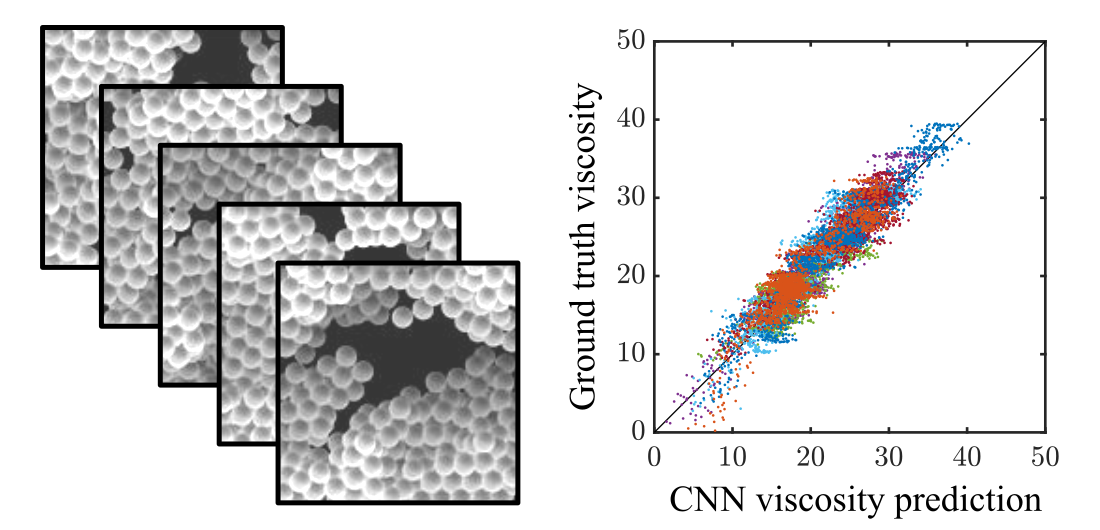
Abstract: Attractive colloidal suspensions can form space-spanning, interconnected networks that give rise to soft solids known as colloidal gels. Their rheology is strongly history-dependent, exhibiting thixotropic behavior in which viscosity evolves with prior shear and microstructural changes. In this talk, I present a simulation-based study of thixotropy and anti-thixotropy in colloidal gels, and demonstrate how electric fields can be used to actively tune their mechanical response. We employ Stokesian dynamics simulations to study attractive colloidal suspensions and rigorously validate the model against the adhesive hard-sphere phase diagram and steady-shear viscosity data. Using a three-interval thixotropy test (3ITT), the system is subjected to low shear, high shear, and then a return to low shear. The final interval, a flow step-down from high to low shear, is the primary focus. As expected for shear-thinning gels, the step-down initially produces a gradual viscosity increase due to bond reformation, characteristic of thixotropic recovery. However, at long times we observe an unexpected viscosity decrease following recovery. We identify this inverse response as anti-thixotropy. Energy landscape analysis reveals that thixotropic recovery reflects the bond recovery after the shear-induced rejuvenation during the high-shear interval, whereas anti-thixotropy arises from long-time shear-induced aging and oversolidification under low shear flow. Building on this understanding, we explore electrical tunability of colloidal gels via dipolophoresis (DIP), arising from the interplay of two nonlinear electrokinetic phenomena, namely induced-charge electrophoresis (ICEP) and dielectrophoresis (DEP). Depending on field frequency and particle polarizability, electric fields can either rejuvenate gels through diffusive bond breaking from the dominance of ICEP or enhance solidification via field-aligned, columnar structures from the dominance of DEP, reminiscent of electrorheological (ER) fluids. Finally, we introduce a convolutional neural network (CNN) framework that links microstructural snapshots to viscosity at low shear rates, offering a data-driven route to predict rheology from microstructure of colloidal gels.

Valeria Ciccone
Nan Hu | Princeton University
On the measurements of viscoelastic fluid in capillary breakup and contraction channel flow
Abstract: In this talk, I will introduce two problems involving viscous and dilute viscoelastic fluids. The first is how to correctly measure the relaxation time using capillary breakup extensional rheometry (CaBER). The second is how to measure the pressure drop of a viscoelastic fluid flowing through a contraction, and how the relaxation time affects our interpretation of the dimensionless results.
In the first study, we identified that the classic interpretation based on the Oldroyd-B model and its well-known 1/3 scaling law always underestimates the true relaxation time—sometimes by more than an order of magnitude. We propose a cross-constrained interpretation method based on the FENE-P model, which enables us to obtain both the relaxation time and the extensibility more accurately and simultaneously.
In the second study, we attempt to resolve the long-standing discrepancy between experimental and theoretical results for the pressure drop of dilute viscoelastic fluids in contraction flows. We identified several inappropriate measurement procedures or interpretations of experimental data (including pressure measurements and relaxation-time measurements). Our experimental and numerical results suggest that there is, in fact, no inherent discrepancy.

September 2026 FoR