
Join the Meeting
Meeting ID: 871 2853 4826 (Password: rheology)
Add to Google Calendar Download Outlook Invite
Seminar Speakers

Nicholas King
Nicholas King | MIT
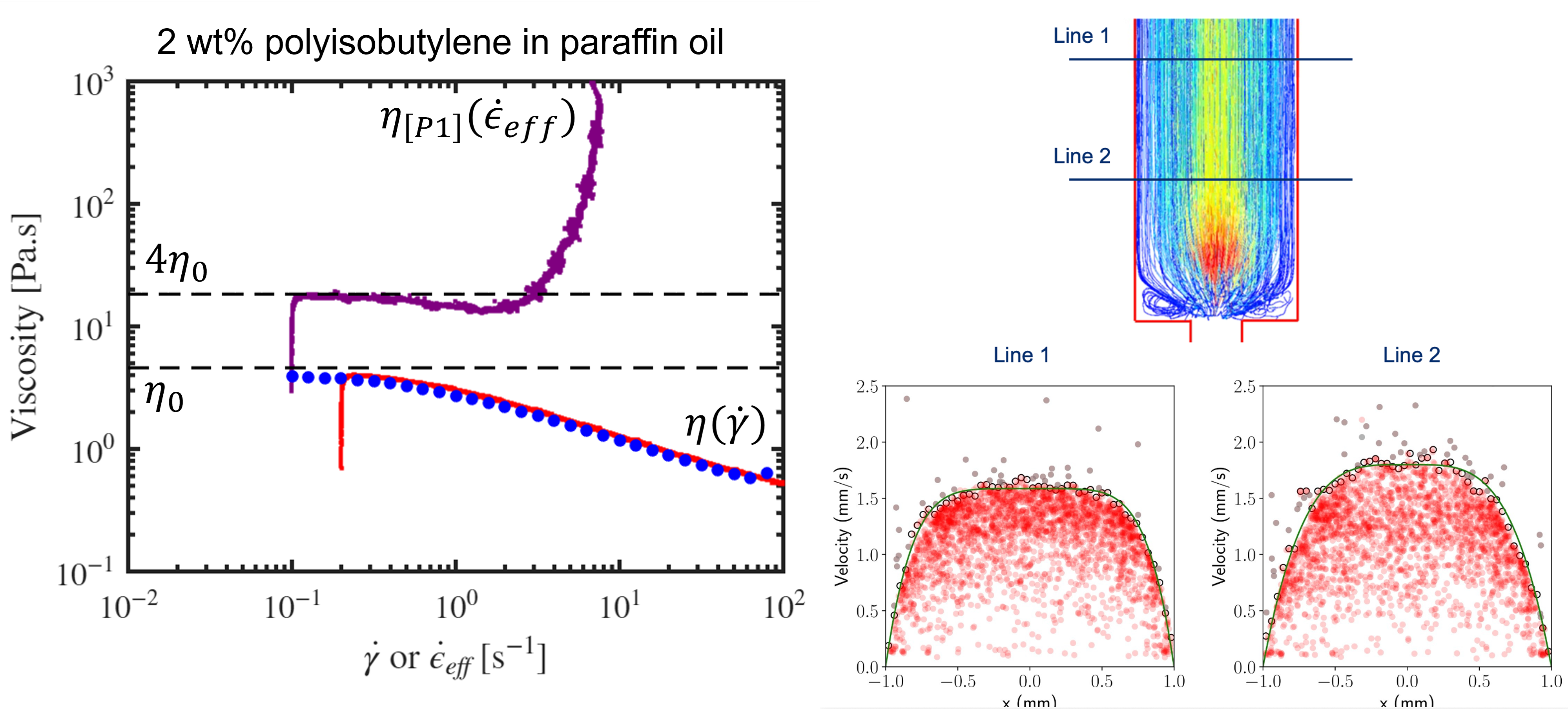
A new approach to measuring both the steady flow curve and the planar extensional viscosity of complex fluids using exponential shear
Abstract:
We revisit the rheometric protocol known as Exponential Shear, first proposed by Doshi and Dealy in 1986. This is a transient strong flow that can be readily imposed in the laboratory using commercial strain-controlled (separate motor and transducer) rheometers which accurately measure both the (exponentially) time-varying torque and normal force exerted by the sample. Numerous studies over the years have proposed competing definitions of an appropriate material function for reporting data obtained from the exponentially time-varying imposed deformation. We revisit this unresolved challenge and carefully reconsider the exponential material kinematics involved and the proper definition of the corresponding material functions. We show that by understanding the time-varying eigenvalues and eigenvectors of both the shearing kinematics and the evolving state of stress in the sample, it is, in fact, possible to use exponential shear to quantitatively map out both the full flow curve (of steady shear viscosity vs shear rate) and the steady planar extensional viscosity curve as a function of deformation rate! Our new approach leverages the kinematic equivalence between steady shearing and planar extensional (or shear-free) flows and reveals rheological equivalence between the two deformation histories. These findings are supported by numerical simulations of a number of properly-frame-invariant nonlinear viscoelastic constitutive models (Phan-Thien Tanner, Giesekus, Rolie-Poly), asymptotic analysis, as well as experiments with several complex fluids.

Julian Kattinger
Julian Kattinger | University of Stuttgart
Time-resolved X-ray-based particle tracking velocimetry for Rheological Characterization
Abstract
In this work, we introduce time-resolved X-ray based particle tracking velocimetry as a quantitative tool for rheological characterization under realistic processing conditions. Conventional rheological characterization techniques, such as capillary rheometry, rely on imposed flow conditions with simplified and largely stationary kinematics, from which material properties are inferred indirectly using global measurements. As a consequence, spatially and temporally resolved information on the internal flow field is typically inaccessible. Optical velocimetry methods, including particle image velocimetry, can provide local velocity data, but their requirement for optical access strongly limits applicability to polymer melts in enclosed, heated geometries. The proposed approach is demonstrated for creeping polymer melt flow inside an actively heated aluminum extrusion nozzle with both cylindrical and tapered flow channel sections, representative of material extrusion processes. Polymer filaments containing dispersed tungsten powder tracer particles were prepared, and a purpose-built experimental setup enabled high frame rate X-ray imaging under operating conditions. Time-resolved tracking of individual tracer particles yields transient velocity fields across the nozzle cross section, from which local strain rate distributions are obtained without assuming predefined flow profiles. The measurements capture the temporal evolution of the flow and reveal a clear transition from an initially plug dominated velocity profile toward a more shear driven behavior. These results highlight the capability of the method to resolve non stationary melt flow dynamics that remain inaccessible to conventional rheological measurements.

November 2026 FoR