
Join the Meeting
Meeting ID: 871 2853 4826 (Password: rheology)
Add to Google Calendar Download Outlook Invite
Seminar Speakers
Rob Campbell, Northeastern University
Modeling the structural origins of increased elastic modulus in brush-mediated colloidal depletion gels

Rob Campbell
Abstract: Colloidal gels are weakly attractive space-spanning particle networks. They have broad applications in areas such as foods, personal care products, and additive manufacturing due to their weak elastic modulus and their viscoelastic response under deformation. These rheological properties depend strongly on the details of the underlying particle-particle interactions. For the same particle volume fraction, changes in the strength, range, and symmetry of interactions will have hierarchical effects on clustering, percolation, network structure, and rheology. Modeling these interactions helps us understand and predict how changes in colloid particle formulation and system composition will change rheology. In turn, this gives engineers more design leverage when creating or modifying soft material products.
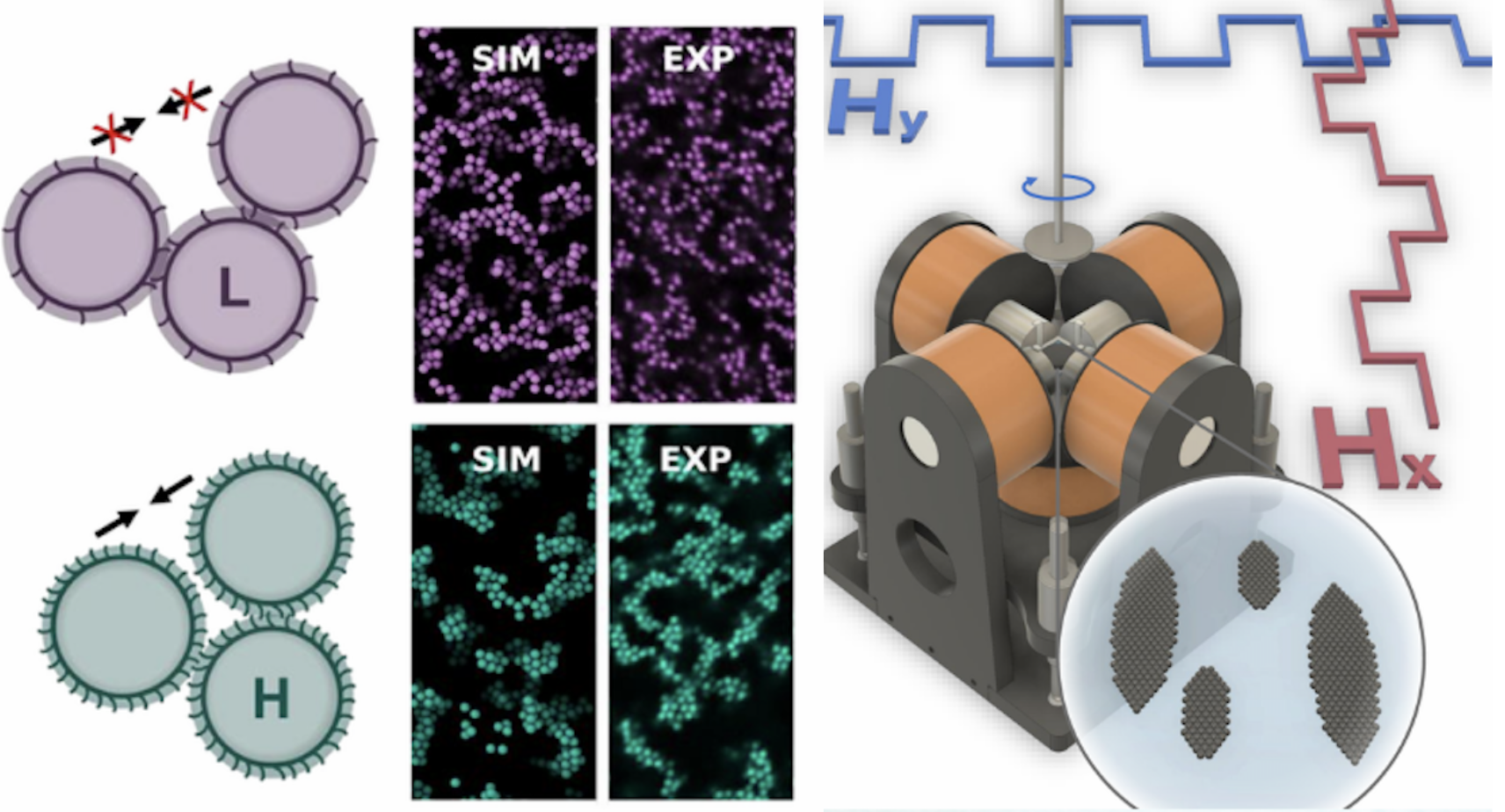
Traditional models use spherical particles with centrosymmetric interactions, such as the geometric excluded volume effect of depletion. In contrast, asymmetric non-central forces are typically created by changing particle geometry and introducing anisotropy, patchy interactions, or surface roughness. Here, we demonstrate a minimal and geometry-preserving approach for adding non-central forces by reducing the density of surface-grafted polymer brushes. At low brush density, partial brush interpenetration introduces an effective angular bending rigidity at particle contacts, despite retaining isotropic particle geometry. This emergent non-central constraint makes it easier to independently assess the effect of interaction asymmetry on structure and rheology.
In this talk I will present how we combine these experiments with simulations and mean-field theory to show that emergent non-central constraints produce hierarchical reorganization of structure across length scales. These brush-mediated interactions suppress local densification, stabilize low-coordination networks, and increase the bulk elastic modulus nearly 3x. Our results establish surface brush density as a control parameter for programming interaction asymmetry into soft particulate matter via combined central and non-central forces, with implications for the mechanical design of disordered systems.
Video:
Guillermo Camacho, University of Granada
Self-assembly and rheo-microscopy under time-dependent magnetic fields

Guillermo Camacho
Abstract: Magnetic colloids are highly versatile smart materials whose properties can be precisely tuned using external magnetic fields. They offer rapid, reversible responses and typically consist of field-sensitive particles dispersed in a non-magnetic liquid carrier. When subjected to a static magnetic field, micron-sized particles self-assemble into columnar structures that align with the field direction. This microstructural organization determines their remarkable characteristics—such as anisotropic physical properties, or field-induced viscosity changes spanning several orders of magnitude—which enable applications ranging from soft robotics, advanced actuators, and biomedicine. However, static fields impose fundamental limitations on achievable microstructures, thereby constraining the scope for property tunability.
The introduction of unsteady fields, which vary in both strength and direction over time, unlocks a vastly richer design space for microstructure formation, enabling materials to be optimized for specific applications. By carefully controlling field parameters such as amplitude, frequency, and spatial dimensionality, one can achieve unprecedented control over colloidal assembly, surpassing the kinetic limitations inherent to static fields and producing novel, highly ordered configurations. This presentation covers a comprehensive exploration of complex field protocols with variable dimensionality, demonstrating their potential for the directed self-assembly and manipulation of magnetic colloids.
The research reveals that toggled fields, which incorporate periodic field-off periods, allow thermal relaxation that enables particles to escape kinetically trapped states and form highly ordered aggregates. This annealing process generates compact, defect-reduced structures with enhanced rheological properties, particularly higher yield stresses. The addition of an orthogonal toggled field component dramatically accelerates self-assembly dynamics and modifies the interaction potential, facilitating template-free fabrication of novel crystalline structures.
Expanding control into higher dimensions, this work implements triaxial unsteady field configurations, including rotating, perturbating, and precessing fields, generated using a custom-built triaxial magnetic field system. These fields produced layered or compact columnar structures, which were directly translated into functional materials with superior mechanical performance. Notably, engineered layered anisotropic magnetic hydrogels developed under these protocols were capable of confining human fibroblast cells, demonstrating potential in bioengineering.
Video:

Future of Rheology - May 2026