
Join the Meeting
Meeting ID: 871 2853 4826 (Password: rheology)
Add to Google Calendar Add to Outlook / Apple / Office 365
Seminar Speakers
Hannah Szafraniec, University of Minnesota
Heterogeneity in red blood cell mechanics drives altered blood rheology in sickle cell disease

Hannah Szafraniec
In sickle cell disease (SCD), polymerization of hemoglobin under deoxygenated conditions causes red blood cells (RBCs) to stiffen, resulting in aberrant blood flow. At the continuum level, deoxygenated blood in SCD exhibits increased shear-thinning and wall friction, but it is not understood how the distribution of RBC properties contributes to whole-blood rheology. Therefore, we developed a novel microfluidic platform to probe the effect of oxygen-dependent RBC stiffness and volume fraction on the rheological properties of blood from patients with SCD. Using high-throughput single-cell measurements, we established that oxygen-dependent changes in red blood cell mechanics are highly heterogeneous. In parallel, we measured the effective rheology of the blood from spatially resolved flow fields and found that increases in effective resistances in heterogeneous suspensions were driven by increases in the proportion of stiff cells, similar macroscopically to the behavior of rigid-particle suspensions. To explore mechanisms leading to the emergent rheology, we developed a computational model to simulate confined flow of heterogeneous mixtures of cells. This allowed us to probe the dynamics of the cells and measure the impact on rheology, which we confirmed experimentally. In the presence of deformable cells, the stiffened cells marginate towards channel walls, increasing effective wall friction. In fully deoxygenated conditions in which all cells are stiffened, significant heterogeneity in cell volume fraction along the direction of flow caused localized jamming, drastically increasing effective viscous flow resistance. Overall, our study directly links single cell properties to blood dynamics in microchannels across individual donors and establishes mechanisms for the apparent rheology of heterogeneous mixtures.
Giancarlo Esposito, Università degli studi di Napoli Federico II
Hydrodynamic interaction of a tandem of Newtonian drops sedimenting in elastoviscoplastic materials

Giancarlo Esposito
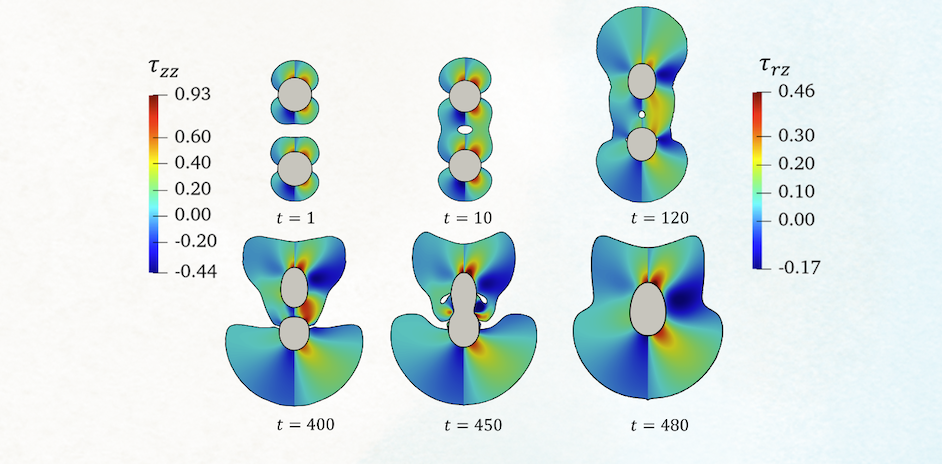
We report the results of a computational study investigating the gravity driven motion and hydrodynamic interaction of a tandem of viscous drops sedimenting in an elastoviscoplastic material, modelled via the Saramito-Herschel-Bulkley constitutive equation. To solve the governing equations, we employ a Finite Volume formulation coupled with a Volume of Fluid method. We validate our numerical setup via comparison with reported experimental results, finding satisfactory agreement in terms of terminal shapes and velocities. For a specific unequal pair of drops, we capture a critical initial separation distance that determines whether the pair coalesces or separates consistently with previous experimental findings. We observe that for small enough initial distances, the two drops are connected through a shear bridge which decreases the effective viscosity of the material in front of the trailing drop, promoting approach and coalescence. Elastic effects are found to be crucial to justify the deviation from the theoretical results obtained with inelastic viscoplastic models, both before and after the merging. We accurately predict distinct experimental phenomena, such as the formation of teardrop-shaped drops and the flow reversal behind them (negative wake). Furthermore, we conduct a comprehensive parametric analysis to examine how geometric parameters such as drop size and relative size, and initial separation, along with material properties including interfacial tension, yield stress, and elastic modulus, influence interaction dynamics. These factors determine whether droplets approach or repel each other or maintain a stable separation distance.

Future of Rheology Feb. 2026