
Join the Meeting
Meeting ID: 871 2853 4826 (Password: rheology)
Add to Google Calendar Download Outlook Invite
Seminar Speakers

Paniz Haghighi
Paniz Haghighi, Northeastern University
Bending Rigidity Reshapes the Structure and Dynamics of Colloidal Gels
Abstract: Colloidal gels, known for their rich rheological features and broad applicability, have been extensively studied both experimentally and through simulations. Generally, the space-spanning network formed by physical bonds between individual colloids governs the mechanics of colloidal gels. As a result, topological changes of this particulate network directly influence the rheology and mechanics of the colloidal gel. On the other hand, meso- and macro-scale features of the network are direct results of interactions at the microscopic level. Beyond the strength of range of interparticle attraction, additional characteristics such as surface roughness, uneven charge distribution, or the presence of surface-bound polymers introduce geometric and energetic constraints that influence how and where bonds form.
In this study, we investigate the extent to which particle connections in colloidal gels are truly random, and how built-in physical constraints influence the formation and architecture of the network. Specifically, we introduce a methodology that limits connectivity through bending rigidity, but without prescribing the number or angles of bonds that form. Although computationally expensive, this approach captures the disordered yet non-arbitrary nature of gel networks, offering a more realistic representation of interparticle forces. Our results demonstrate that this method not only improves the accuracy of network characterization but also reveals how different gel morphologies arise from the interplay of microscopic interactions and kinetic assembly processes.
Video:

Noah Eckman
© Rod Searcey 2025
Noah Eckman, Stanford University
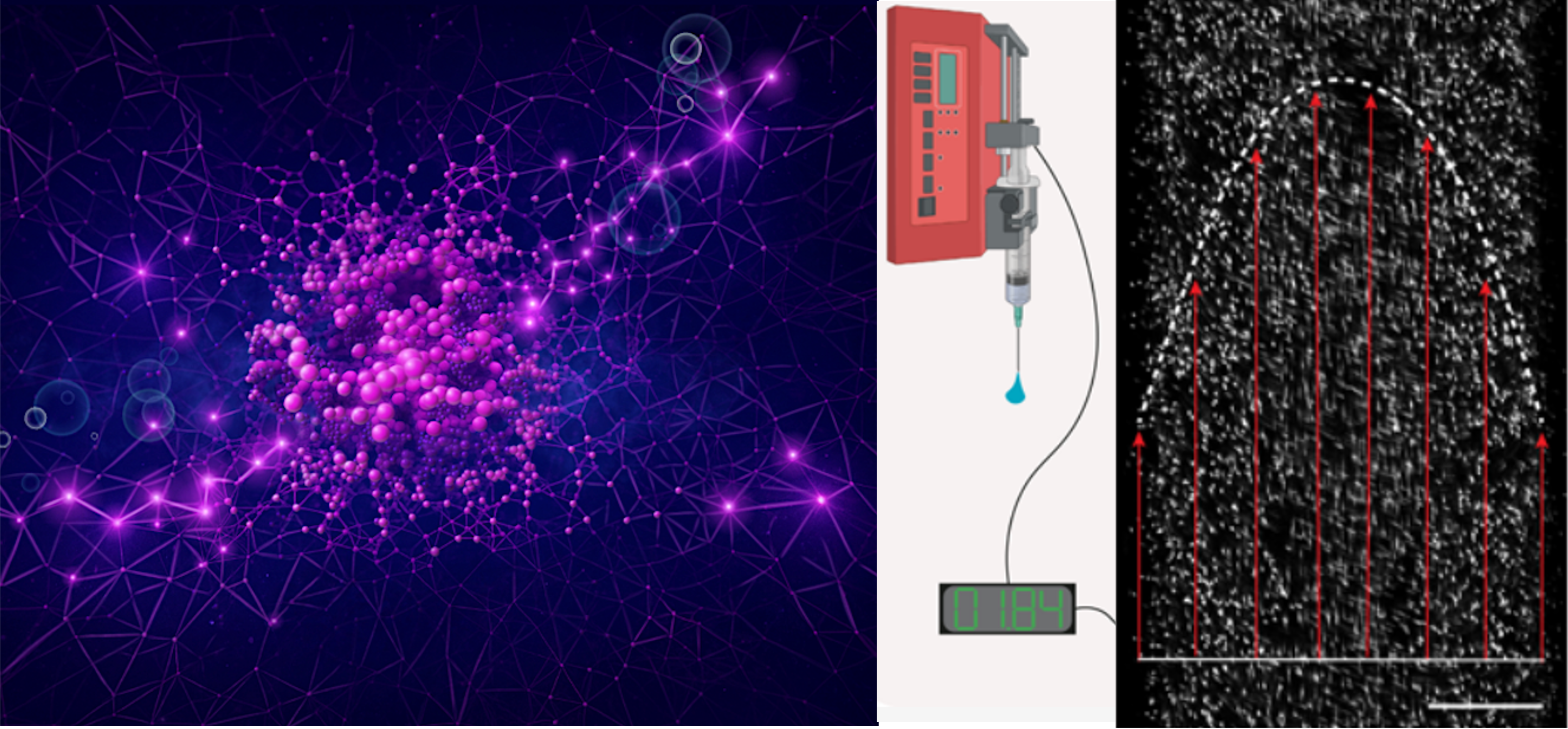
Surprises in injection force and flow rheology of physical hydrogels
Abstract: Materials utilizing supramolecular assembly offer distinct advantages in applications requiring injection or extrusion, arising from the lack of permanent covalent crosslinks in favor of those which can dynamically rearrange. Dynamic materials may be used to directly deliver therapeutic cells and biologic drugs which are sensitive to the localized shear stress and inhomogeneities in the flow field, highlighting the need for better characterization of the physics of capillary flow for these set of materials. A suite of rheological and mechanical testing tools exists to probe the linear and low-shear rate (below approximately 100 sec-1) behavior, but unexpected behaviors may emerge at high shear rates, such as shear banding and wall-slip, even at low Reynolds number.
In this talk, I will utilize different dynamic hydrogel systems with hydrophobically-driven associations, ionic interactions, and dynamic covalent bonds in order to understand a spectrum of crosslink strength and material chemistry. By using LAOS experiments to determine the time-varying yielding transition, I will show that the yielding process of the dynamic hydrogels cannot be defined by a single yield stress value and is more accurately described by a range and velocity of yielding. Critically, I will connect the speed of yielding to cell viability measurements during high-shear rate injections in these materials.
I will then demonstrate the use of capillary flow rheology to explain non-monotonic trends in injection force with regards to crosslink dynamicity of a novel dynamic hydrogel system. By connecting measurements including rheometry, viscometry, and an in situ capillary microscope optical rheometer, we find that strong wall slip dominates the flow profile at high shear rate, leading to unexpectedly low injection forces, and nonuniform trends in injection force with respect to crosslink dynamics. Finally, we give new criteria for hand injectability based on a rheological model which accounts for power law shear-thinning and wall slip.
Video:

FoR June 2026