
Join the Meeting
Meeting ID: 871 2853 4826 (Password: rheology)
Add to Google Calendar Download Outlook Invite
Seminar Speakers

Charles Knisely
Charles Knisely | University of Minnesota, Twin Cities
Utilizing reverse poloxamers to control stability and rheology of P407/oil drug delivery systems
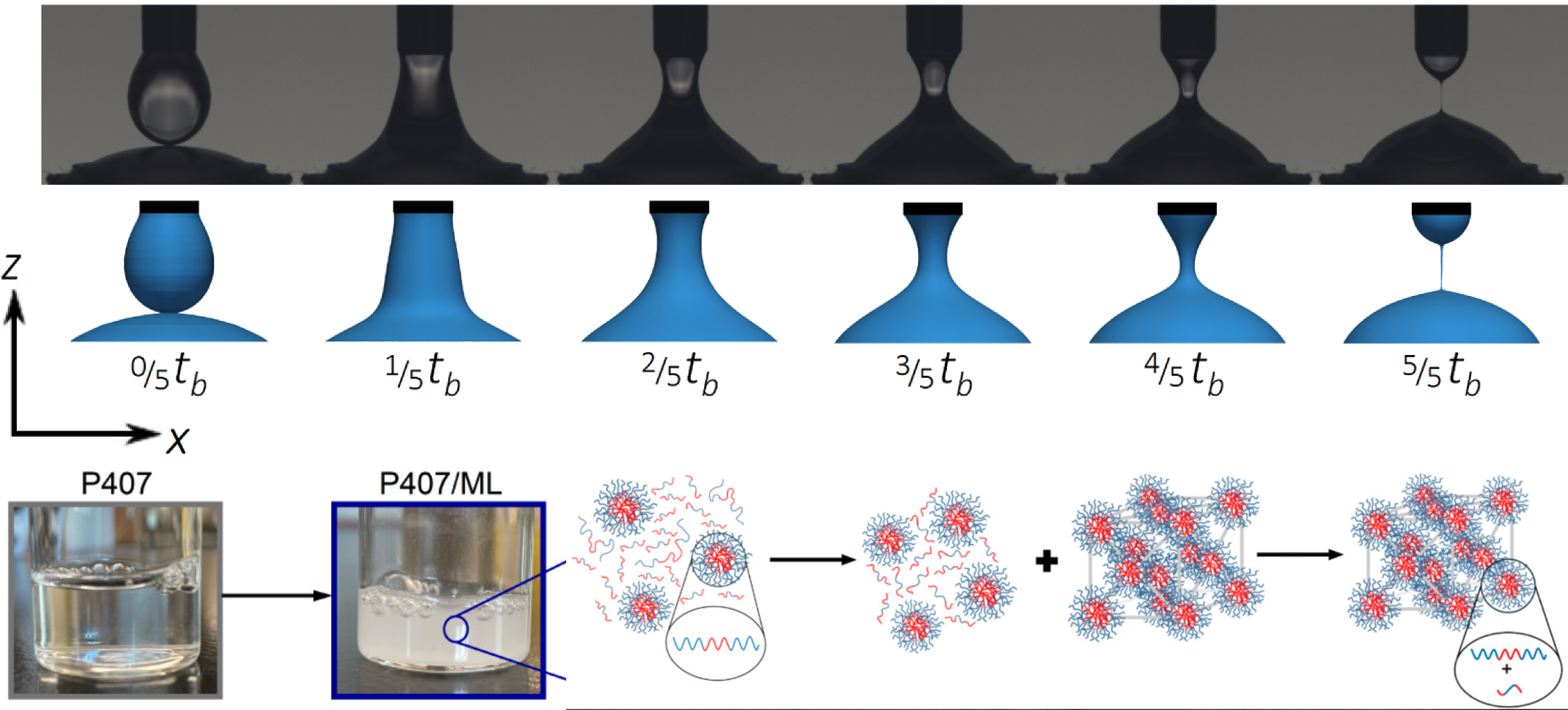
Abstract: Poloxamers are ABA triblock polymer surfactants that exhibit unique thermoresponsive micellization and ordering behavior. In particular, Poloxamer 407 (P407) is promising for applications requiring drug transport across low-permeability biological barriers, due to its FDA approval and rapid disorder-to-order transition near physiological temperature. The rheological properties of neat P407 formulations are well understood; however, such applications often require the addition of chemical permeation enhancers (CPEs) to facilitate drug diffusion through the barrier. These CPEs often interfere with the transition process, altering transition temperature and decreasing modulus. Recently, methyl laurate (ML) – a methyl ester oil – was identified as a promising CPE additive for delivering antibiotic ciprofloxacin across the eardrum, with ordered P407/ML soft solids demonstrating desirable storage moduli. However, ML challenges the formulation stability and significantly decreases the transition temperature.
Here, we explore adding reverse poloxamers (RPs) 17R2 and 17R4 – BAB triblock polymers with a reverse chain architecture to P407 – to selectively control structure-property relationships and improve stability. Temperature-dependent oscillatory shear rheology, differential scanning calorimetry, and small-angle x-ray scattering are used to observe thermal self-assembly and establish structure-property relationships. RPs dramatically improve formulation stability and maximum complex modulus. However, only the more hydrophilic 17R4 noticeably alters the self-assembly and rheology of P407/ML. Due to the increased solubility of 17R4 vs. 17R2, the dehydration process of 17R4 is well-separated from that of P407, allowing solubilized 17R4 chains to delay the ordering transition by obstructing the overlap of P407 micelles. Such differences in RP dehydration drive localization in different regions of the micelles, with the hydrophobic 17R2 lining the core-corona interface and 17R4 localizing in the corona region. From these findings, a framework is developed for accurately predicting the rheological and structural properties of P407/ML solutions, facilitating the selection of optimal RP type and composition for future delivery applications.

Ricardo El Khoury
Ricardo El Khoury |CEMEF, Mines Paris - PSL
Dripping onto Droplet: a new capillary breakup extensional rheometry technique
Abstract: We report a mixed experimental-numerical analysis devoted to the capillary thinning dynamics of Newtonian (glycerol and silicone oil) and non-Newtonian polymeric solutions (polyethylene oxide, polyacrylamide, and xanthan gum) spanning a wide viscosity range. Their extensional behaviour is studied through a new configuration called here dripping onto droplet, i.e., a millimetric top drop generated by a nozzle touches and coalesces with a bottom drop cap of the same fluid contained in a millimetric tube, giving rise to a fluid filament whose diameter decreases with time due to capillary effects. The time decay of the filament diameter is then measured, along with the breakup time.
These quantities are used to underline four filament thinning regimes: (I) the capillary-inertial regime, which is dominated by a competition between capillary and inertial stresses; (II) the capillary-viscous regime driving by a capillary and viscous stress balance; (III) the mixed capillary-inertio-viscous regime dominated by capillary, inertial and viscous stresses; (IV) and the mixed capillary-viscoelastic regime emerging from a balance between capillary, viscous and elastic stresses. These regimes are described by equations whose key parameters are the fluids’ surface tension, viscosity, and extensional relaxation time. Hence, by using these equations, one can fit the experimental and numerical data and estimate the mentioned properties. Finally, we highlight that, using the dripping-onto-droplet technique, we can measure extensional relaxation times as small as ~ 1ms.
