
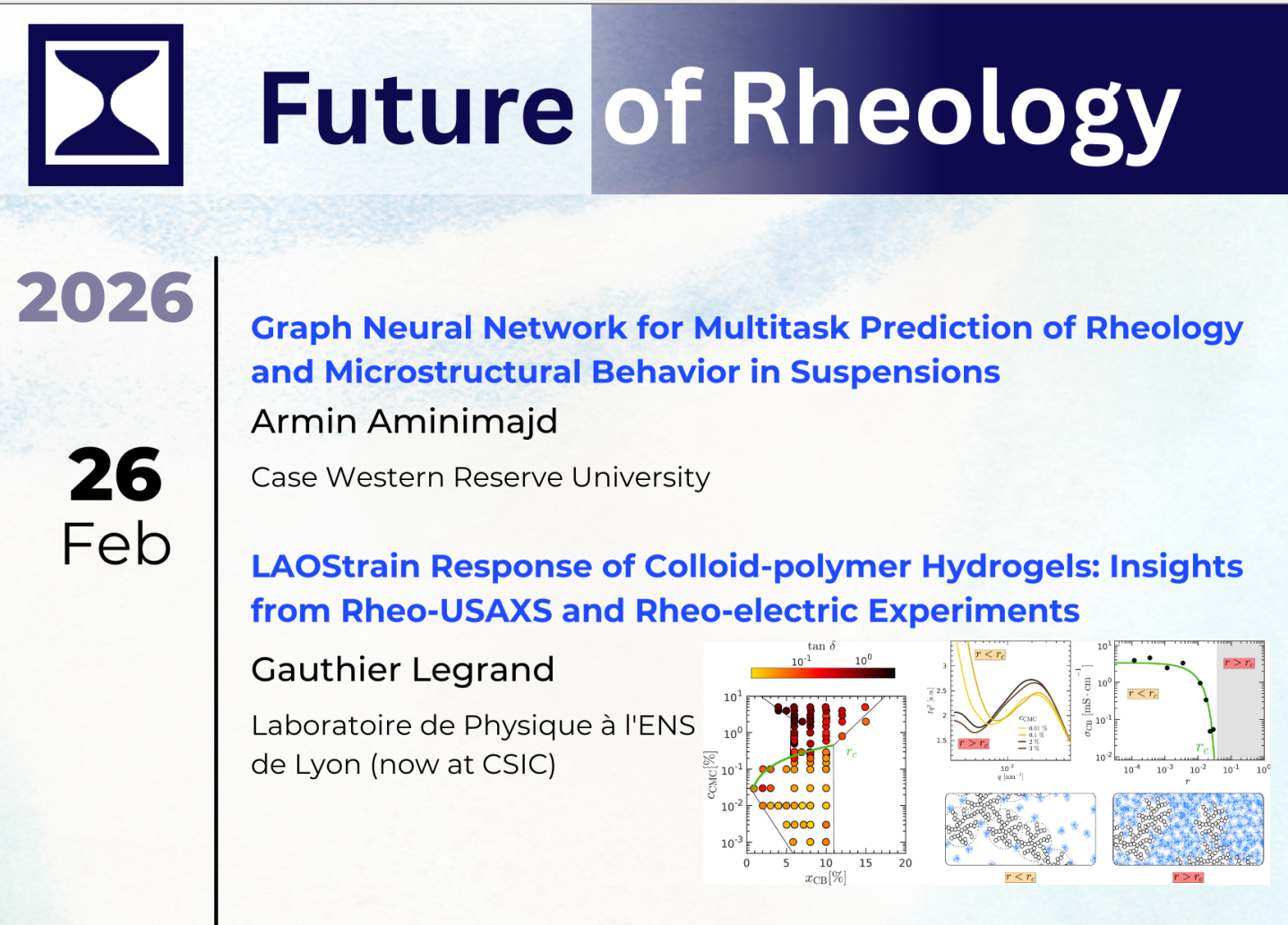
Speaker:
Armin Aminimajd, (Case Western Reserve University)
Title:
Graph Neural Network for Multitask Prediction of Rheology and Microstructural Behavior in Suspensions
Authors:
Armin Aminimajd (Case Western Reserve University), Joao Maia (Case Western Reserve University), Abhinendra Singh (Case Western Reserve University)
Abstract:
Understanding rheological behavior of suspensions is crucial for optimizing their performance across various applications in nature and in the industry.However, experimental methods often struggle with reproducibility, scalability, and accurate microstructural measurements. Traditional particulate simulations, on the other hand, are computationally expensive and intensive. Graph Neural Networks (GNNs) have emerged as powerful tools for capturing latent patterns and interactions in complex graph-based systems. This study presents a multitask learning framework that utilizes GNNs to predict microstructural and rheological properties, including viscosity, frictional coordination number, particle pressure. Suspensions from semi-dilute to dense systems were simulated using Lubrication-Flow Discrete Element Method (LF-DEM), thus generating a wide range of complex rheological behaviors ranging from continuous shear thickening, discontinuous shear thickening and shear-jamming conditions. The suspension data were further converted into graph representations to feed the GNN, where particle and interparticle interactions are represented as nodes and edges. The models were trained independently for each packing fraction 𝜑, shear stress σ_xy, strain, sliding, and rolling frictions to predict unseen configurations. Results demonstrate high correlation coefficient, with minimal Mean Absolute Error (MAE) representing robust technique against changing parameters (suspension conditions), though performance decreases near jamming due to high fluctuation and instability. This approach provides a promising tool for exploring particulate systems across diverse conditions.
Speaker:
Gauthier Legrand, Laboratoire de Physique à l’ENS de Lyon, now at CSIC
Title:
LAOStrain Response of Colloid-polymer Hydrogels: Insights from Rheo-USAXS and Rheo-electric Experiments
Authors:
Baeza, G.P. (Université Jean Monnet Saint-Etienne, France); Manneville, S. (Univ Lyon, Ens de Lyon, Univ Claude Bernard, CNRS, Laboratoire de Physique, France); Divoux, T. (Univ Lyon, Ens de Lyon, Univ Claude Bernard, CNRS, Laboratoire de Physique, Lyon, France)
Abstract:
Colloid-polymer hydrogels play a key role in applications ranging from flow batteries to drug delivery. This study examines hydrogels made from hydrophobic colloidal soot—carbon black (CB)—and carboxymethylcellulose (CMC), a food additive polymer with hydrophobic groups that bind to CB. These hydrogels form either conductive CB network stabilized by CMC or insulating structures where CB acts as a physical cross-linker in a CMC matrix. We compare the yielding behavior of these two CB-CMC hydrogels under Large Amplitude Oscillatory Shear (LAOS) using rheometry, Ultra Small Angle X-ray Scattering, and electrical measurements. Conductive hydrogels show a pronounced G’’ overshoot (similar to the Payne effect) and a yield strain of around 10%, marked by a sudden conductivity drop due to network disruption. Insulating hydrogels yield at ~100% strain amplitude, after which they flow and develop partial conductivity via a transient CB network, confirmed by rheo-SAXS. Our findings, supported by an in-depth LAOStrain analysis, provide a detailed picture of the non-linear mechanics of CB-CMC hydrogels. This works aims at broadening the knowledge of polymer-nanoparticle systems in the case of an aqueous dispersions of hydrophobic, fractal and conductive particles associated with a polymer with associative properties.

Future of Rheology Feb. 2026