
Join the Meeting
Meeting ID: 871 2853 4826 (Password: rheology)
Add to Google Calendar Download Outlook Invite
Seminar Speakers

Boqian Yan
Boqian Yan | Northeastern University
Unraveling Stress Relaxation of Suspension Droplets Impacting on Deep Pool
Abstract: Dense suspensions can exhibit liquid-like or solid-like behavior depending on particle volume fraction and applied stress. However, under rapid impact, direct experimental identification of the material state remains challenging. In this work, we show that the impact of cornstarch suspension droplets on a deep liquid pool provides a useful indicator of the underlying state. Solid-like droplets tend to suppress pool cavity formation, whereas liquid-like droplets generate a distinct cavity. To explain this state-dependent behavior, we investigate the mechanism linking suspension state to the pool response. Furthermore, we carried out step-strain rheological measurements to provide experimental support that cavity suppression corresponds to a solid-like state of the suspension droplets. We found that, at high particle volume fractions and high applied stresses, the suspensions exhibit a two-step relaxation response with a long initial relaxation timescale, suggesting that the droplets respond more like a solid during impact and thereby suppress pool cavity formation. Our results suggest that droplet impact on a liquid pool can serve as a simple and accessible probe of dense suspension state under rapid impact conditions and may also be useful for applications in which cavity formation needs to be controlled.

Valeria Ciccone
Valeria Ciccone | University of Manchester
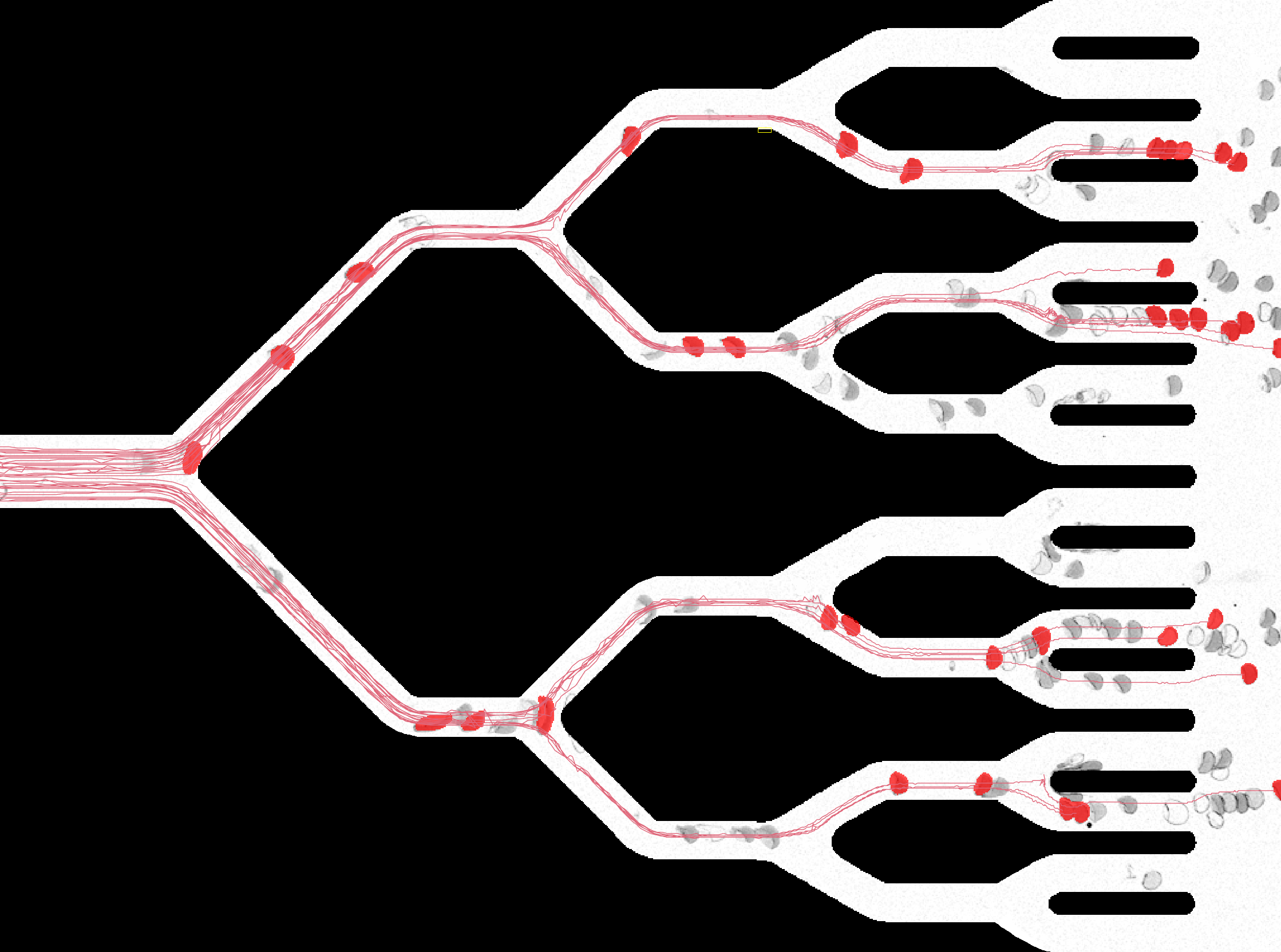
Inhomogeneous dispersion and memory effects of soft suspensions in complex media
Abstract: Despite the essential role of the microvasculature in maintaining overall health and functionality of tissues, blood flow and transport mechanisms in this network remain poorly understood. This is in great part because the description of blood as a simple fluid breaks down when the size of red blood cells (RBCs) is comparable to that of smaller vessels. On that scale, the effect of the adaptation of RBCs to the complex geometry of a network remains an open question.
To study the flow of RBCs we use a biomimetic model which consists of elastic capsules which have been shown to accurately capture the fluid mechanics of RBCs in straight confined tubes. We investigate the dispersion of this soft suspension in a homogenous branched network as a function of volume fraction of capsules and of capillary number (the ratio of viscous to elastic forces). We show that branching and curvature combine to create a non-uniform distribution of particles at the outlet, an effect that depends on the number of branch generations and flow parameters. Using a branched network as an inlet produces a flow characterised by regularly spaced shear bands which is radically different to that obtained using a localised capsule source to feed a channel. Either flow persists over long distances, demonstrating the potential for memory effects in large networks like the microcirculation.

August 2026 FoR