
Join the Meeting
Meeting ID: 871 2853 4826 (Password: rheology)
Add to Google Calendar Download Outlook Invite
Seminar Speakers
Suspension balance modelling of microcirculatory blood flows capturing cell free layer

Hugo Castillo
Hugo Castillo Sanchez, FAMU-FSU College of Engineering
Abstract: Microcirculatory blood flow is featured by red blood cells (RBCs) migrating away from the vessel wall. This process leads to the formation of a cell-laden core and a near-wall cell-free layer (CFL), which is physiologically essential to maintain a relatively low apparent viscosity and to promote platelet margination needed for healthy hemostasis. Cellular-scale direct computational models have been able to directly capture these phenomena accurately, but these approaches can be computationally prohibitive for vascular network or organ-scale simulations. Continuum models, on the other hand, can provide a faster alternative that can be feasibly extended to at-scale applications. In this talk, we will present our recently developed continuum modified suspension balance model (MSBM) for capturing the CFL in microcirculatory blood flows, where we introduce a lift-force flux term operated on the RBC phase to capture the hydrodynamic “lift” effect generated from the wall on the RBCs. We implement our new model in open-source software (i. e. OpenFOAM) to simulate blood flows through microvascular channels and tubes. The results are validated against existing experiments and cellular blood flow simulations in terms of velocity and concentration profiles. We will show that the new SBM can capture successfully the CFL and other relevant phenomena seen in blood flows (i. e. the Fåhræus-Lindquist effect) in various hemorheological conditions. This work establishes a novel continuum computational framework that can efficiently capture the microstructural heterogeneity and non-Newtonian flow behavior of blood under confinement.
Video:
Shear-induced nematic alignment in polysulfone melts

Sara Daryoush
Sara Daryoush, Penn State
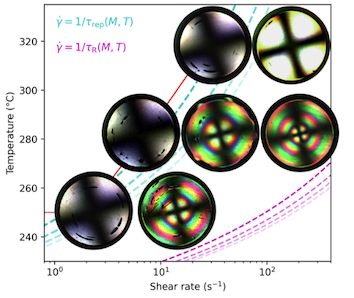
Abstract: Polymer melt processing often requires conditions of temperature and shear that create flow-induced structures which deeply affect the properties of the resulting material. Such effect is connected to chain stretching, often leading to shear-induced nematic alignment of at least the longest chains, reported for rod-like polymers but also polyolefins. The chain stiffness of a polysulfone melt is numerically determined from the tangent correlation decay along a freely rotating chain model. Its reasonable chain stiffness and linearity, verified by very good agreement of the linear viscoelastic data with a branch-on-branch (BoB) tube model, as well as its inability to crystallize make it a suitable material to explore the temperature dependence of the nematic alignment. Such behavior is monitored by both rheology, exhibiting a failure of the Cox-Merz rule, and birefringence by means of an in situ reflection polariscope. The critical shear rate for nematic alignment at various temperatures is determined and contrasted with that expected from the Rouse relaxation time of the longest chains, often considered as the control parameter. Although the onset shear rate for nematic alignment share the same temperature dependence as the chain relaxation times, suggesting chain stretching is the underlying mechanism, the critical shear rate is much smaller than expected. The anomalous behavior of polysulfone is discussed in relation with possible π-stacking interactions stabilizing the nematic domains.
Video:

Future of Rheology Feb. 2026